The Lumber Industry Boom
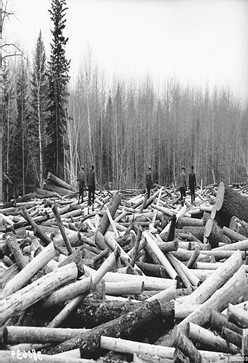
A history of industry in the city of Marinette and Marinette County is essentially, a history of lumbering. The first sawmill was built in Marinette in 1831 by William Farnsworth and Charles Brush. The last log was cut exactly 100 years later. In the meantime, 10 billion feet of logs had been floated down the Menominee River, to the Harbor of Marinette where the river entered the Bay of Green Bay. At times the annual timber harvest packed the river solid from bank to bank for 22 miles to the mouth of the river. *1
At its peak in the 1890’s there were over 9,000 men working in the lumber industry. 5000 of which worked in 200 logging camps on the Menominee river and over 4,000 working in the Marinette and Menominee sawmills. For perspective in 1890 the population of the attire city of Green Bay was only 9,069.
As the Lumber business Boomed, so did Marinette, from a population of only 478 in 1853 it grew to 3059 by 1860. Between 1890 and 1900. population soared from 7,710 to 16,195 in 1900.*2 In 1900 Marinette was the 10th largest in the state of Wisconsin.
The industry reached its peak in 1898 with over 30 sawmills on the Menominee River of which 21 were in the cities of Marinette and Menominee. It was during this period that the Menominee River area formed the largest lumber activity center in the Country. It was recognized for having the most sawmills in operation, the largest number of affiliated industries and the number 1 Lumber shipping port in the world.*3
Harvesting Lumber in Northern Wisconsin
White Pine was the first type of trees logged in our area. Although the logs were heavy and hard to handle, they floated quite well in water. Thus, the rivers were used to move the logs from the Northwoods to the sawmills located in Marinette and Menominee.
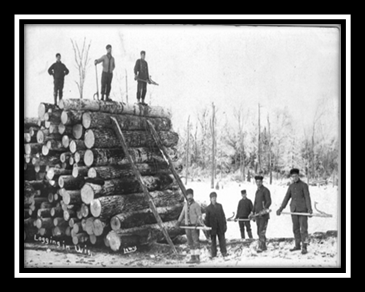
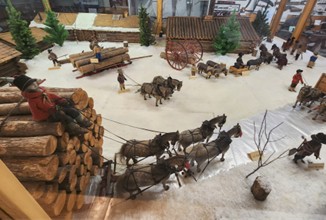
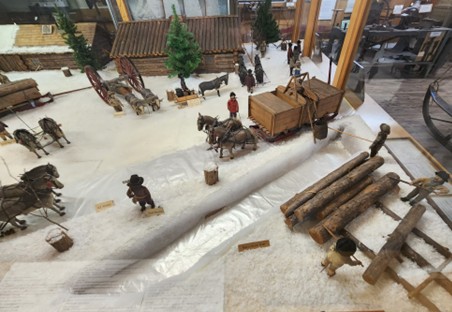
Work in a Lumber camp was done in the winter. Cold and snow meant good sledding, and sledding was the only way to move the logs to the riverbank. A horse or ox dragged each log to a collection area (skidway). The logs were piled then loaded on a wooden sleigh.
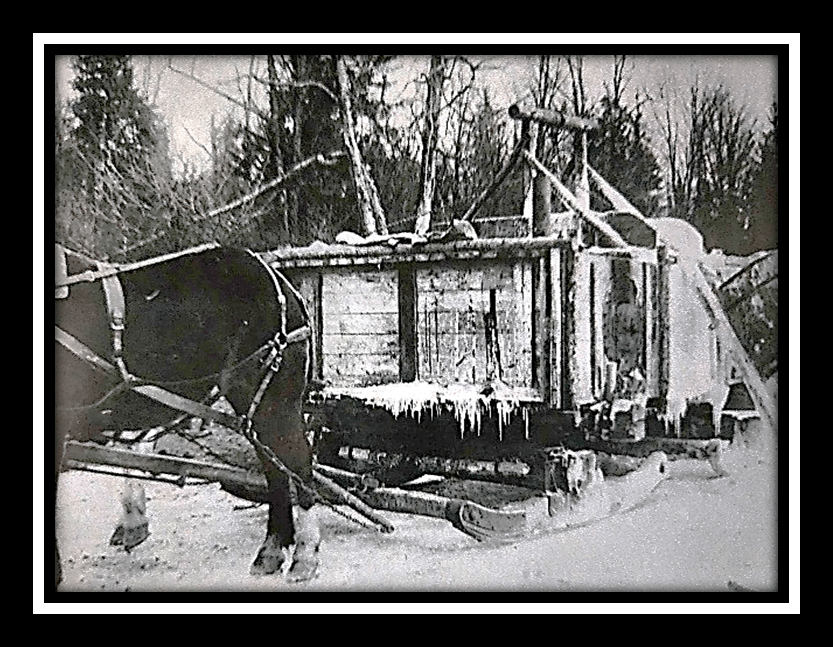
Once chained in place, horses pulled the sleigh on an ice road to the riverbank. The ice roads were maintained by use of a horse drawn water sled which sprinkled water along the path to allow for faster and easier hauling.
Logs were stacked on the riverbank until the spring thaw. When river levels were high the logs were pushed into the river to float down to the sawmills. This was called “the log drive”.
Each Log was branded with the owner’s mark. The role of the Boom Company was to sort out logs and measure them. This was done in the river on floating log booms chained to rock cribs. Once sorted they were floated down to their sawmill owners.
In the spring, the numerous sawmills went into operation. They produced lumber, shighles, and other wood products. The greatest market for lumber was Milwaukee and Chicago. Sail boats were initially used to get the lumber to Great Lake Michigan port cities.
Lumberjacks were paid their wages after arriving in town after winter was over. Many went to work in sawmills while others returned to their farms.
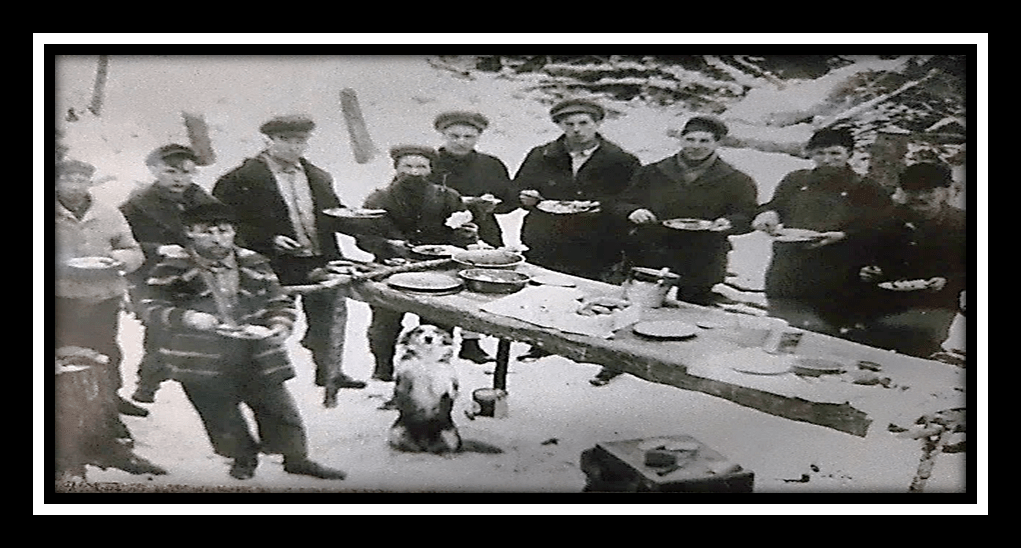
A hot lunch went a long way in keeping the loggers going on cold winter days. Note – camp dog on up on hind paws waiting for a scrap.
Pictures below are a small representation of the glass enclosed 8′ X 16′ beautiful Diorama hand carved by John Mayer, a former lumberjack, which shows how the process worked.
*1 Population figures from City of Marinette’s web site, a brief History of Marinette. *2 Reprinted from Wisconsin and Upper Michigan PROFILE section of Milwaukee Sentinel January 11th, 1953. *3 Menominee Herald Leader, April 20, 1940, page 4.
 Marinette County Historical Society