“Queen Marinette” the Legendary figure the City of Marinette is named after.
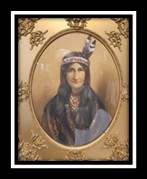
Marinette Chevalier was born in 1793 in Post lake, Wisconsin. Her father was Bartholomew Chevalier a French-Canadian fur trader and her mother a native American Indian.
Queen Marinette moved with her parents to the Green Bay area in the early 1800’s. There she met and married her first husband, John B. Jacobs, a fur trader. With Jacobs she had 3 children.
In 1823 John B. Jacobs and Marinette, still living in Green Bay, partnered with a Mr. William Farnsworth. The three took over the Trading Post located near the mouth of the Menominee River which had been established by the American Fur Company. An area that at that time was known as the Menominee River District*1 (see Menominee River district section below.)
Soon after arriving in the Menominee district John Jacobs, her husband, went back to Canada his original home and never returned. Marinette and Farnsworth’s then joined in a common law marriage. From the onset of her arrival in the district, it became apparent that the native Americans who traded furs for food and supplies preferred dealing with Marinette. Marinette was considered by most that knew her as a very capable businesswomen, shrewd but honest trader, and very friendly to all that visited or lived in the area.
With the Trading post in the good hands of Marinette. Farnsworth was able to partner with a Charles R. Brush from Detroit and the two joined forces and built the first sawmill on the Menominee River in the year 1931. This mill stood approximately where North Raymond Street meets the river.
With Farnsworth Marinette had 3 more children, 2 sons and a daughter. Farnsworth left Queen Marinette and the district in 1833 and resettled in the Sheboygan River area.
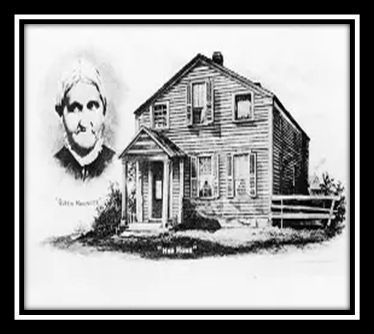
Queen Marinette remained in the district, raised her family and developed the business into a large trading center. She had been educated during her youth in early mission schools which also allowed her to advise the Menominee people on dealings with white settlers, lumber companies, and the U.S. government. Marinette also began to purchase much of the land that would later encompass much of the city at that time. Her residence pictured below was the first framed home on the Menominee river.
There are several versions of how she received the name Marinette. One of the most popular stories comes from the fact that she was named after Marie Antoinette, Queen of France, who died the same year Marinette was born. “Her said name” was a supposedly a contraction of the Queens name. Another version simply states that the name, Marinette, was easier for her Native American sisters and brothers pronounce then the name Marie Antoinette *2
The addition of “Queen” to Marinette’s name, came about because women in those times rarely occupied the position of prominence she held in the commercial world. At the time of Queen Marinette’s death in 1865 she was regarded as one of the most remarkable figures, male or female, in the early history of the Great Lakes region.
Menominee River District
The Menominee River District in the early 1800’s was the land comprising the areas on both sides of the Menominee river. This land included Menominee on the north side of the river, Marinette on the southern side and Menekaunee on the south side, at the river’s mouth.
The district at that time was part of what was called the Michigan Territory and remained as such until 1836. In 1836 the Menominee River became the boundary line between Michigan territory that would become the state of Michigan 1n 1837 and the Wisconsin territory that became a state in 1848.
*1 Fred Burke, Marinette Eagle Star Residents of District article 1950’s *2 July 15, 1876; Marinette Eagle-Star, Dec. 7, 1946; Wis. Mag. Hist., 5; Green Bay Hist. Bull., 5 (1929), pp. 7-13.Dictionary of Wisconsin biography
 Marinette County Historical Society